Journal · Hosting · Oct 14, 2026
Dinner party games for adults that feel good to host and easy to join
A practical hosting plan with three playable low-prep games, timing suggestions and ways to include quiet guests.
By Nexora Vault
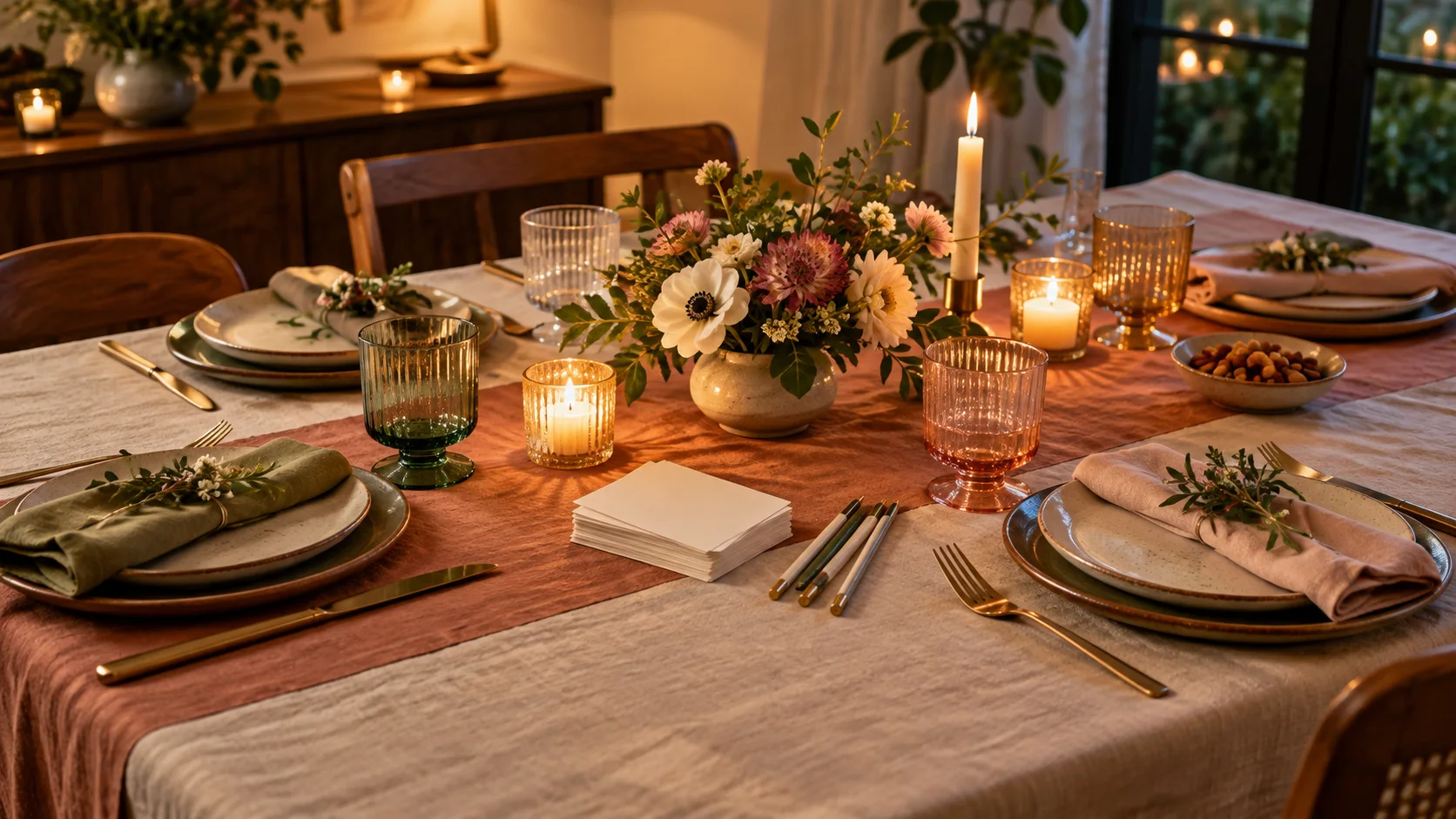
The best game at a dinner party does not feel like a mandatory team-building exercise. It gives people an easy way into conversation, lets them pass without an explanation and ends before the table gets tired. You can do that with paper, pens and one host who knows the rules.
Choose an activity for the moment, not just the number of guests. Arrival calls for something people can join at different times. Between courses suits a short seated round. After dinner can hold a longer collaborative puzzle if the group wants one. For a mixed group, avoid games that require personal secrets, drinking, public performance or deep knowledge of one another.
Set the room up for a good start
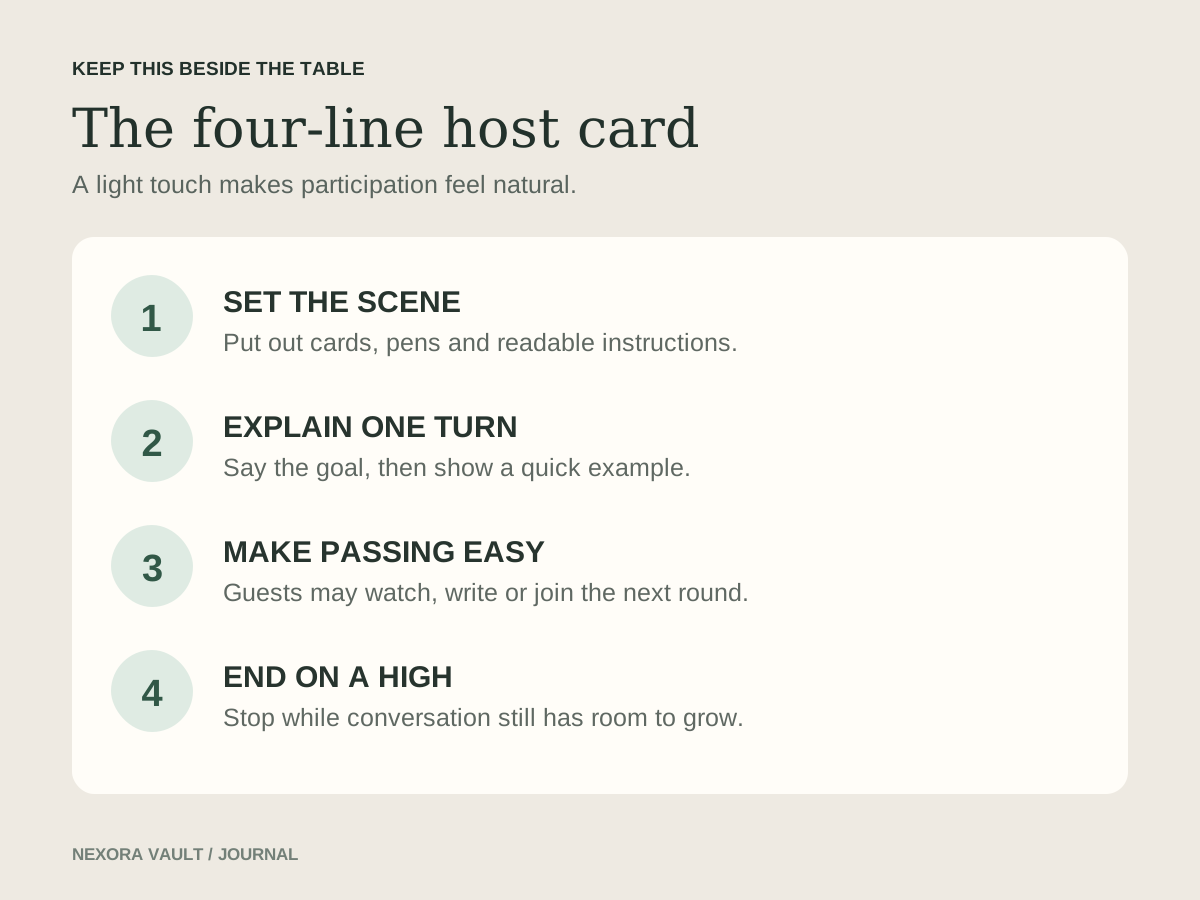
Put one pen and a few small cards at every place. Test the light where people will read. Keep a large-print version of any instructions or read them aloud once; do not make small decorative type the only way to play. Ask the host to explain the goal, demonstrate one turn and say, “You can pass or write an answer instead.” That sentence makes joining easier without turning the moment into an announcement about anyone's needs.
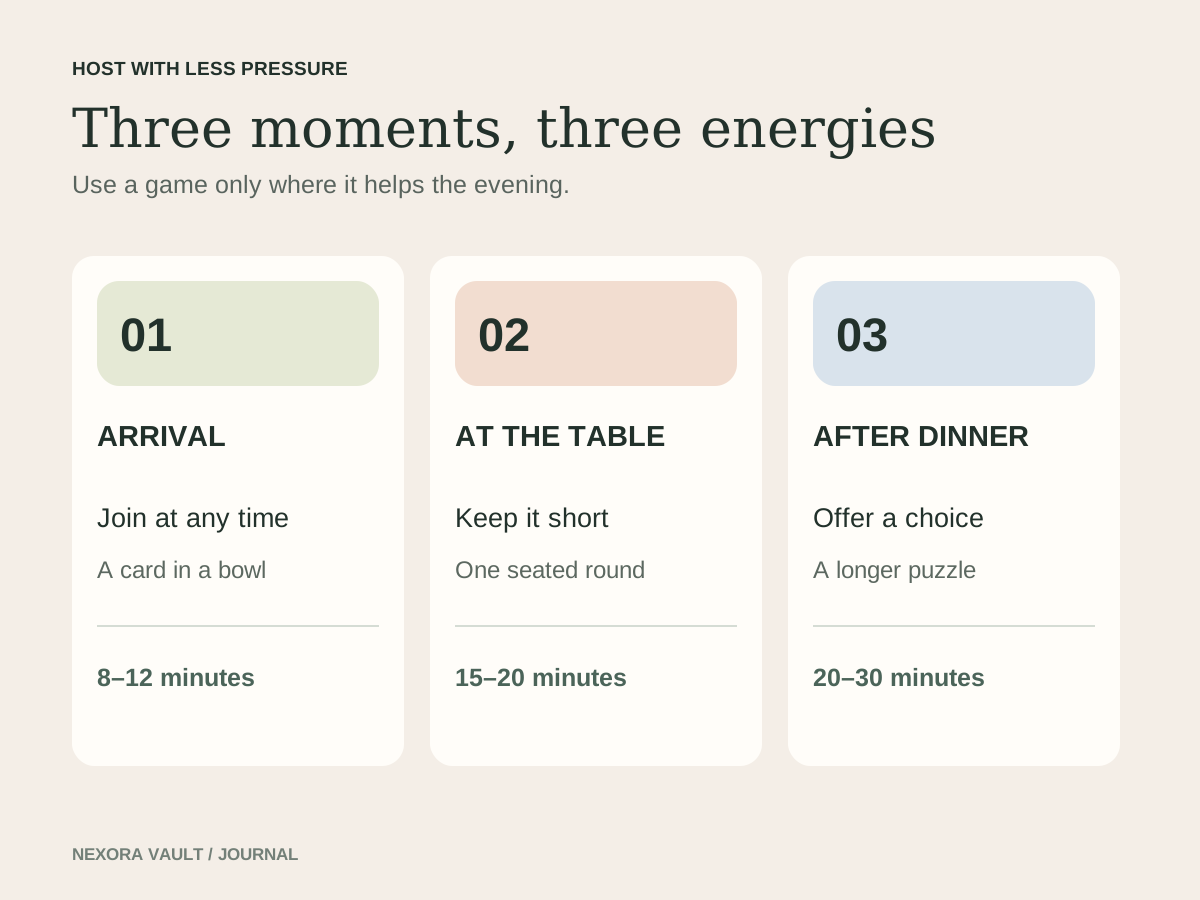
Decide where a game belongs in the evening before printing twenty pages. A ten-minute activity after the main course often works better than a complex game while food is being served. You can offer a low-pressure prompt on arrival, run one short round at the table and leave the longer option available only if people want more.
Game one: The Small Detail Exchange
Best moment: arrival or the first drink; time: about 8–12 minutes; materials: one blank card and pen per guest. This works even if guests arrive at different times. Ask everyone to write a small, ordinary detail from their week that they enjoyed: a sound, a meal, a place, a phrase or an object. No names. Put the cards in a bowl. As people settle, draw one and invite the table to imagine the scene behind it. The writer can reveal themselves, add one sentence or let the card stand alone.
Try prompts such as “a tiny moment you would replay,” “something you noticed on a walk,” or “a food you were glad to eat.” Avoid “your biggest regret” or anything that turns a warm-up into an unexpected confession. If the group is quiet, the host goes first with a modest example: “The bakery gave me the warm loaf from the oven.” End after a few cards; save the rest for later instead of making everyone wait for their turn.
Why it works: the detail gives people something concrete to discuss without demanding a polished story. There is no scoring and no correct answer. For a group that already knows each other, ask people to guess which detail belongs to whom; for strangers, skip the guessing.
Game two: Build a Place in Five Clues
Best moment: between courses or after the main meal; time: 15–20 minutes; materials: five prompt cards per small group, paper and pens. Divide the table into groups of three or four. Each group invents a fictional place from five clues: a landscape, a rule, a sound, something locals protect and a visitor's surprise. The host can prepare the clues on cards or read them aloud. Give groups six minutes to decide what the place is like, then three minutes to sketch a map or write a postcard. Each group shares one detail and the other groups ask one question.
For example: a garden on a rooftop; every door is painted blue; there is a bell at dusk; people protect an old tree; visitors arrive by boat. The group does not need to draw well. A list, sentence or spoken explanation is enough. If the table is small, everyone can build one place together. Finish with a quick vote on the most intriguing detail, or skip voting and keep it collaborative.
This game feels different from a quiz because the pleasure is making something together. Keep the clue set short. If discussion starts naturally, the host can end the formal round and let people continue talking.
Game three: The Gentle Mystery Envelope
Best moment: after dinner; time: about 20–30 minutes; materials: six paper clues and an answer sheet kept by the host. Write a fictional, low-stakes question such as “Which guest left the recipe card in the library?” Create six clues, each revealing one piece of the answer. Divide the clues among players so nobody holds the whole solution. Read a two-sentence introduction, give the group ten minutes to share clues, then ask them to agree on an answer and explain which clues support it.
Here is a mini version you can use tonight. Three friends—Ari, Bea and Cal—each brought one item: a book, a candle or a recipe card. The items were left in the hall, kitchen or library. Clue 1: the candle was left in the hall. Clue 2: Cal brought the book. Clue 3: Bea did not bring the candle. Clue 4: the book was left in the kitchen. Clue 5: Ari did not go to the library. The only item left for Bea is the recipe card, and the only location left for it is the library. Read the clues once, hand them out, and let the group solve it; keep the explanation hidden until they have tried.
To make your own version, write the solution first, then clues that eliminate all but one assignment. Test it yourself or with someone outside the party. A mystery that can be solved two ways frustrates players; an answer revealed too quickly gives them nothing to do. Offer a hint after a few quiet minutes: ask which items and locations are already fixed. Make it clear that people can watch, hold a clue or help reason aloud.
A flexible two-hour hosting plan
Use this as a rhythm, not a strict timetable. During the first twenty minutes, greet arrivals and leave Small Detail cards available. Over dinner, let conversation lead; run Build a Place only if there is a natural pause. After food, offer the Mystery Envelope as an option rather than an obligation. Reserve the last part of the evening for unstructured conversation. If guests are enjoying themselves without games, the plan has already succeeded.
For an easy first ten minutes, First Spark is a free printable table activity. If you want a complete longer evening with prepared cards and a host guide, After Hours includes three separate experiences for adults and older teens, with suggested 45- and 90-minute routes. Its files are a separate digital purchase; the three games above are fully playable from this article without buying anything.
Make the invitation honest
Tell guests what sort of evening to expect: “Dinner and a few easy table activities; you can just watch if you prefer.” Ask about access needs and dietary needs privately, and arrange the room so nobody has to move suddenly to participate. Keep phone photos optional. A good game helps people feel present with one another; a good host knows when to put the cards away.