Journal · Small Business · Oct 14, 2026
How to quote a cleaning job without guessing your price
Scope the work, estimate crew hours, count real costs and write a quote a customer can understand.
By Nexora Vault

A cleaning quote has two jobs. It needs to cover the time and costs of doing the work, and it needs to tell the customer what they are buying. A neat total without a clear scope can fail both sides: you lose time on an unexpected oven, while the customer thought it was included all along.
This is a method for building a pre-tax estimate from your own figures. It is not a market-rate chart or a promise of profit. Labour rules, tax, insurance, local prices and contract requirements vary, so check those for your business before sending a real quote.
1. Record the job before you price it
Ask for the location, property type, approximate size, rooms, condition, cleaning frequency, access arrangements and desired date. Then ask what “clean” means for this job. A recurring maintenance visit, first deep clean, move-out clean and post-renovation visit can require very different work even in the same property. Photos may help, but get permission and do not promise a final fixed price from incomplete images if a site visit is needed.
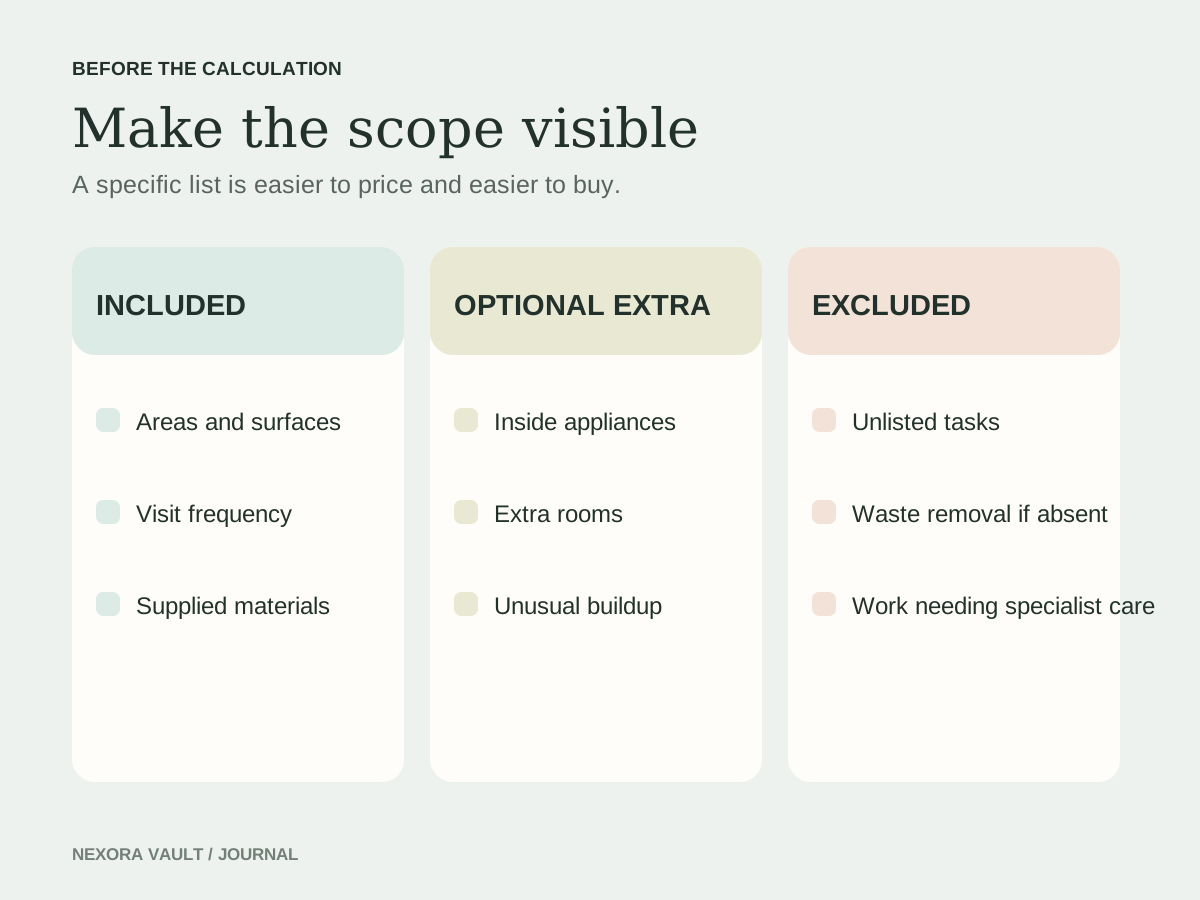
Walk through every area that matters: kitchens and appliances, bathrooms, floors, interior windows, high surfaces, clutter, pets, parking, stairs and water or power access. Note fragile finishes or products the customer does not want used. Record who supplies consumables, whether the space is furnished, and whether anything must be moved. Put a clear included, optional extra or excluded label beside each task.
If the customer wants a price before you can inspect the space, state the assumptions and what would trigger a revised quote. For example: “Assumes one maintained kitchen and two bathrooms; inside-oven cleaning is excluded.” This is clearer than a vague “standard clean” label.
2. Convert the visit into paid crew time
Estimate person-hours, not only time on the clock. Two cleaners working two hours create four person-hours of labour. Add paid setup, loading, travel or disposal time where your business pays for it. A first visit may take longer than a recurring one. Keep a note of why you chose the estimate: room count, condition, task list and past comparable jobs. Your own completed-job records are more useful than someone else's generic rate.
Avoid an optimistic estimate that assumes every surface is clear and every appliance is empty. Check whether the client expects you to move items, wait for access or work around occupants. If you cannot assess a high-uncertainty task, offer a range or a separately approved extra with a clear basis. Do not promise a fixed scope and later add a surprise charge for work that was visible at the start.
3. Add the costs you actually carry
Start with labour: person-hours multiplied by your true paid labour cost per hour, including any employer costs that apply. Add paid travel, supplies, equipment allowance, waste disposal and a sensible share of overhead such as insurance, admin and software. If you are a solo operator, your own working time is still a cost; “what is left” is not a substitute for paying yourself.
Write each amount in one currency. Keep tax separate until you know whether, and how, it applies to this customer and location. Avoid mixing a net-of-tax cost with a tax-inclusive selling price. You can use a simple sheet, but preserve the assumptions so that you can compare the estimate with what actually happened.
4. Choose a margin, then calculate the price correctly
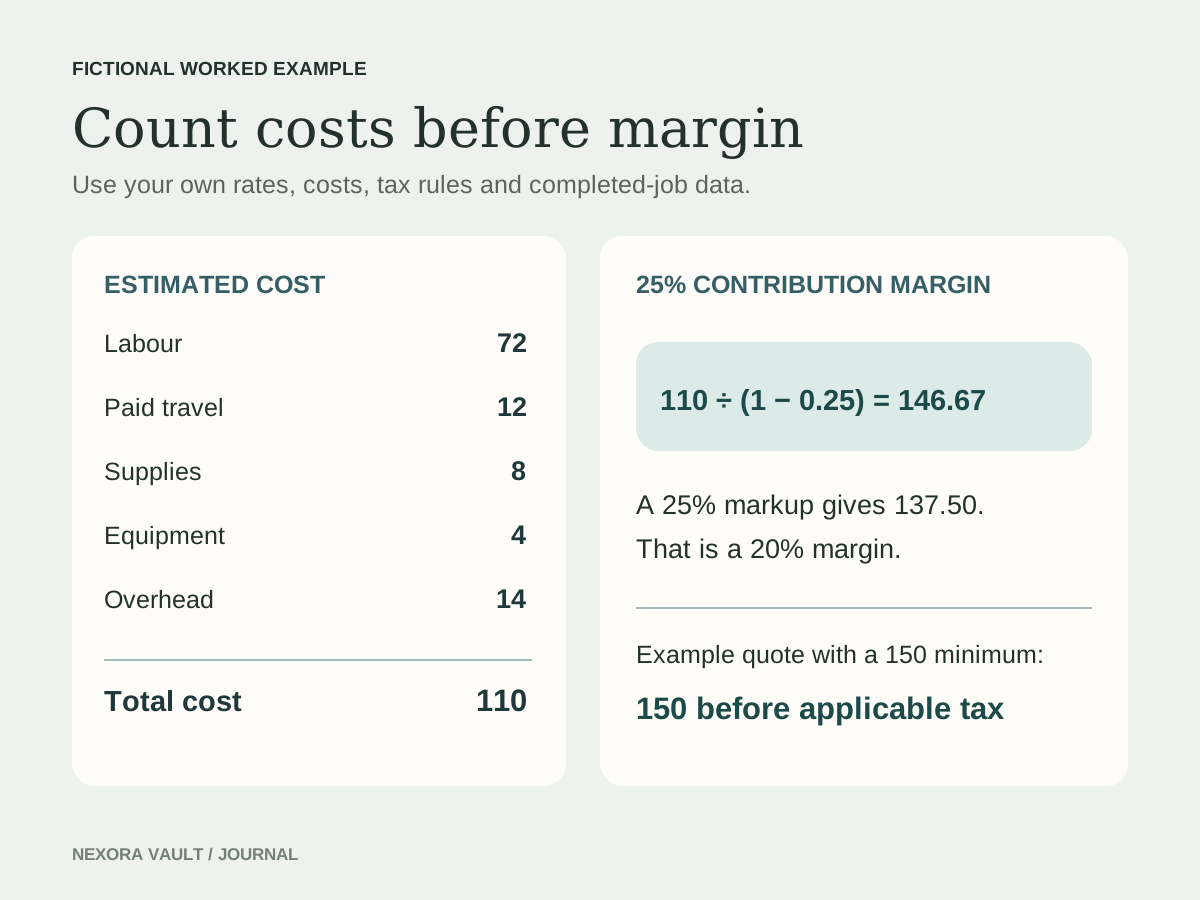
Margin and markup use different denominators. If direct and allocated costs are 110 and you want a 25% contribution margin on the selling price, divide by 0.75: 110 ÷ (1 − 0.25) = 146.67, before tax. Adding 25% to 110 gives 137.50; that is a 25% markup on cost, but only a 20% margin on the resulting price. Neither target is universally right. Choose a target from your business plan and check it against real completed jobs.
Here is one fictional calculation in currency units:
- Four person-hours of labour at 18 each: 72.
- Paid travel: 12. Supplies: 8. Equipment allowance: 4. Allocated overhead: 14.
- Total estimated cost: 110. At a 25% contribution-margin target, the pre-tax price is 146.67.
- If your minimum call-out charge is 150, the suggested quote becomes 150 before any applicable tax or explicitly priced extras.
This does not mean the job will deliver full net profit. The target is based on estimates; extra time, rework and missed overhead can change the result. It also does not tell you whether 150 is competitive or affordable for your market. Test the number against your own costs and customer scope rather than copying the example.
5. Test what happens if the job runs long
Suppose both cleaners need one more hour. That is two more person-hours, not one. At 18 per person-hour, labour cost rises by 36 before any extra travel or supplies. If you want the same 25% contribution margin, that extra 36 requires 36 ÷ 0.75 = 48 more in the selling price. You may not be able to charge that after agreeing a fixed quote, which is why the initial scope and time estimate matter.
Run at least one realistic extra-time scenario before sending a large quote. Ask what might cause it: heavy buildup, delayed access, a new room or extra requested tasks. Decide which risk belongs in your fixed estimate and which should require the customer's approval before work begins. The free Cleaning Quote Calculator lets you enter crew time, paid travel, labour, supplies, equipment, overhead, target contribution margin and an extra-hour scenario using your own values. Its result is an estimate; its product page explains the limits.
6. Write the customer-facing quote
The customer should be able to read the document without seeing your internal cost model. Include the customer and job address; date and quote validity; visit frequency; included areas and tasks; excluded work; supplied materials; estimated duration or service window; the pre-tax price; any applicable tax; optional extras; payment terms; and how changes are approved. If a deposit is requested, state the amount and timing. Put a contact for questions on the document.
Use plain words. “Inside oven excluded” is clearer than “deep-clean add-on may apply.” If access, parking or water supply are essential assumptions, put them near the scope. For recurring work, say whether the first visit costs more and when the service or price may be reviewed. Keep the client copy concise, but never conceal a meaningful exclusion in tiny text.
7. Compare estimate with actual after the job
Record actual person-hours, travel, supplies and any extra work. Work out the actual contribution from the agreed price and compare it with the estimate. If a category regularly runs long, update the time assumption rather than blaming every individual job. Ask whether the written scope matched what the client expected; a profitable job can still create a poor customer experience if the quote was unclear.
For a reusable scope and handover checklist, ClearScope is a separate tool. For customer quote documents, optional extras, tax and deposit settings, saved jobs and actual-cost comparisons, Cleaning Quote & Job Profit Studio covers a broader workflow. The method above works without either product: start with a careful scope, use your real numbers and review each completed job.